General
Compression and combustion gases enter the engine crank case through the gap between pistons and cylinder walls. These blow-by gases are vented back to the intake incl. fine oil mist what deposits in the intake manifold, on inlet ports and valves. Further more oil combustion residues contaminate the exhaust system.
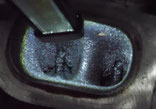
On direct injected engines the oil mist builds up a crusty carbon layer on the hot inlet ports and valves. Over time the air flow gets more and more disturbed and restricted. Older port injected engines are less affected as the inlet ports are constantly flushed with gas. In any case contamination of the catalytic converter and O2 sensors with unburned oil residues is dentrimental.
Most of the blow-by can simply be sucked out of the crank case by a vent hose that connects to the intake manifold. To prevent from any condensates the crank case can also be vented actively by positive crank case ventilation. However, the amount of oil mist that finds its way to the intake barely depends on the vent concept or the amount of blow-by gases. Important are oil quality and effectiveness of air oil separation.
Our light weight air oil separtator (65grams empty) is designed to fit in typical vent line installations. If the vent line routing is suitable for one of the 4 available fitting configurations and if there is sufficient room for the 60ml catch can, installation can be done within a view minutes. The oil separator fittings have 12mm OD, offered hoses (option) are good for 10 to 12mm tubes/fittings, angled installation of the can is possible.
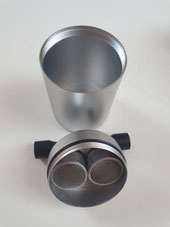
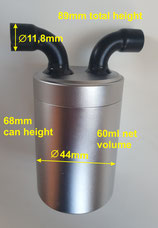

The oil is extracted by two fine stainless steel filter inlays (mesh 400 - about 35my mesh size). The amount depends on the engine oil filling volume, the oil quality and age. 10-15ml (0W40 ACEA A3) per liter oil filling are collected over an oil change interval: 60-70% over the first 5'000km and 30-40% up to 10'000km. More milage does not contribute any further significant quantity when apparently most volatile incredients are gone. A longer oil usage may not be reasonable. Based on 4-8 liter fill volume extrapolated to 100'000km the separator will prevent 0,5-1,0 liter oil from entering the intake.
The amount of catched oil may help diagnose condition of the thermostat function, fan control, oil quality and perfomance of OEM oil separation. In case water is evident in the extract (milky slime), it may only be conden-sate - avoid ice build up in Winter - but it may indicate an internal leakage as well, e.g. head gasket failure.